In the world of professional jewelry manufacturing and diamond trading, carat weight is often the first attribute a customer considers. However, for a jeweler, understanding carat weight goes far beyond a number on a scale. It involves a complex interplay of physics, geometry, and market economics. While carat weight significantly dictates the price of a stone, it does not always equate to visual size or overall beauty. This guide explores the technical nuances of carat weight, its relationship with cut quality, and how to navigate the “magic numbers” of the diamond market to provide the best value to your clients.
Carat weight versus physical size: The common misconception
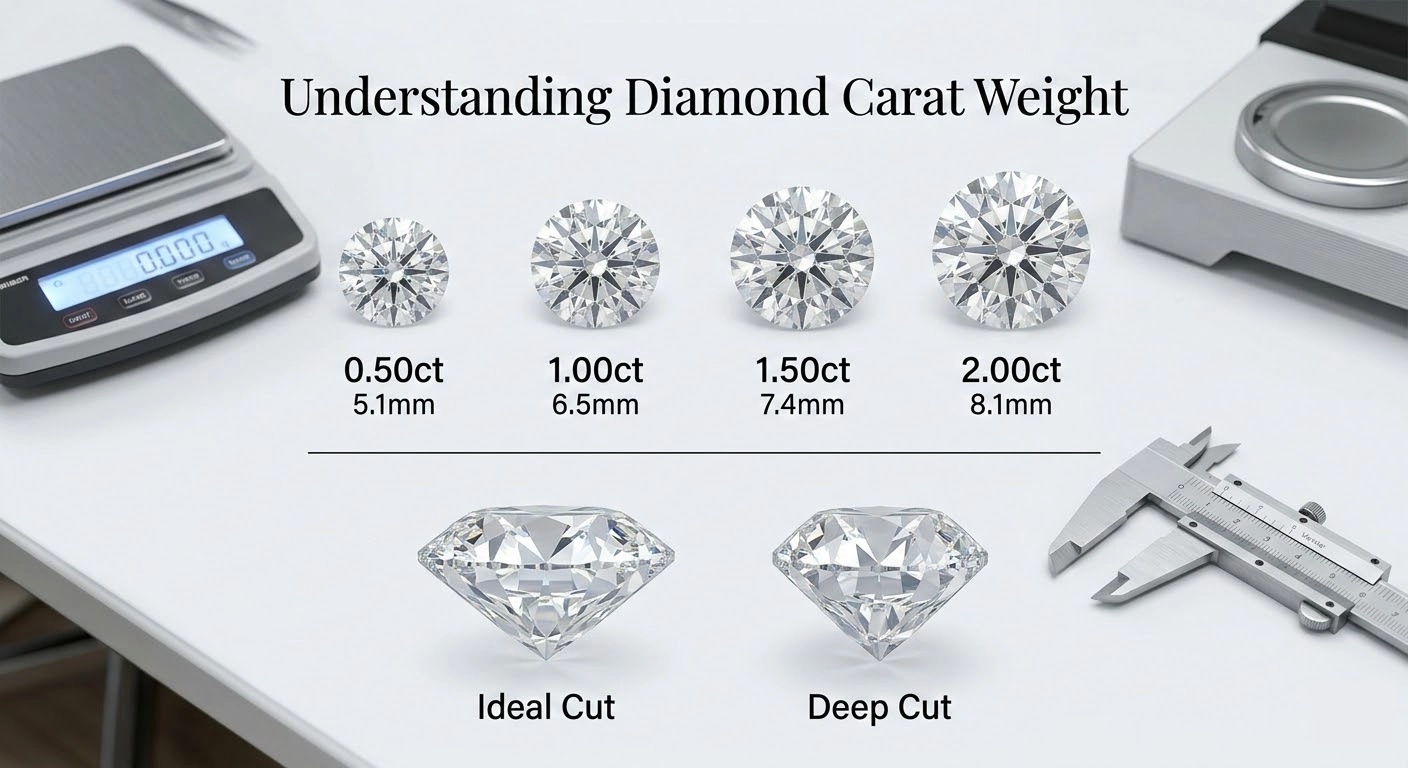
The most frequent misunderstanding in the industry is the confusion between weight and size. A “carat” is a unit of mass, specifically equal to 200 milligrams. It is not a measurement of a diamond’s dimensions. Because diamonds are three-dimensional objects, two stones with the exact same carat weight can have significantly different physical appearances depending on how they are cut.
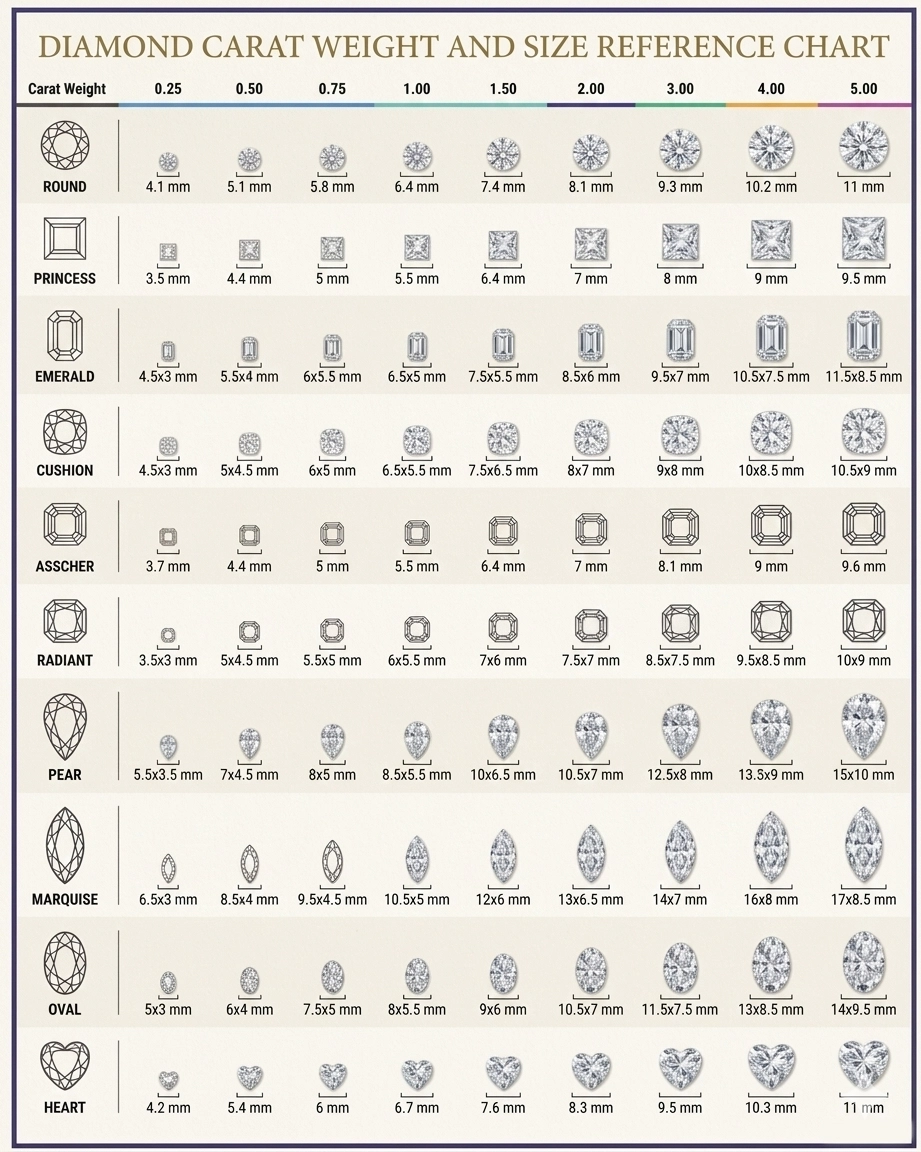
When a diamond is cut too deep, much of its weight is “hidden” in the pavilion (the bottom part of the stone). This results in a diamond that looks smaller from the top than its weight suggests. Conversely, a diamond cut too shallow might have a large surface area (diameter) but will suffer from poor light performance, often appearing “glassy” or dull. For a round brilliant diamond, a 1.00-carat stone should ideally have a diameter of approximately 6.5mm. If a 1.00-carat stone measures only 6.1mm, it is “heavy” and poorly proportioned, meaning the customer is paying for weight they cannot see.
Why cut remains the most critical factor for visual appeal
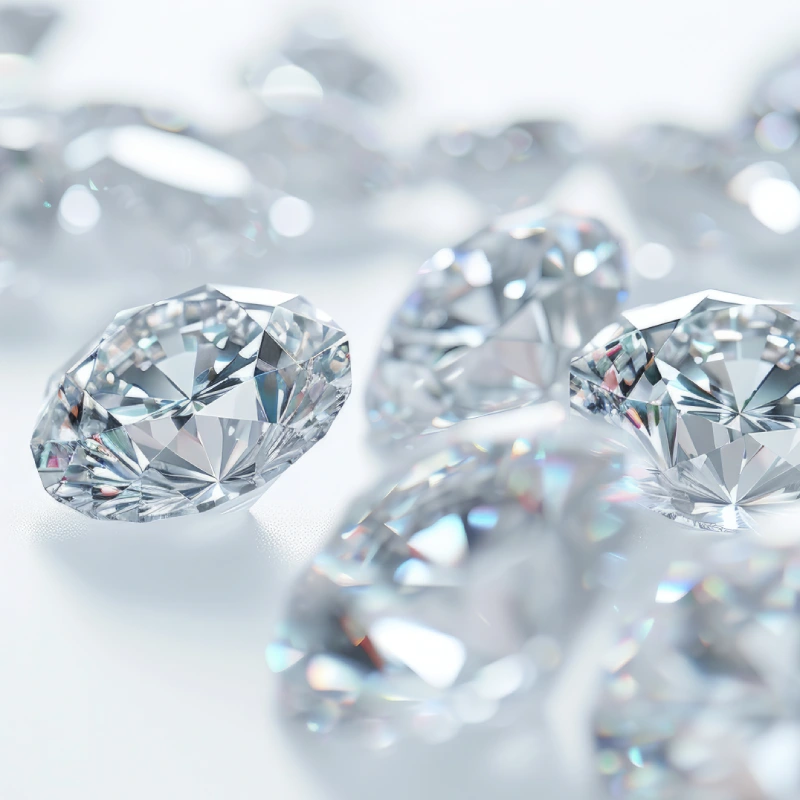
In professional diamond grading, we often say that “cut is king.” The quality of the cut determines how the diamond handles light. A perfectly cut diamond will reflect almost all the light that enters through the table, creating the sparkle (brilliance, fire, and scintillation) that diamonds are famous for.
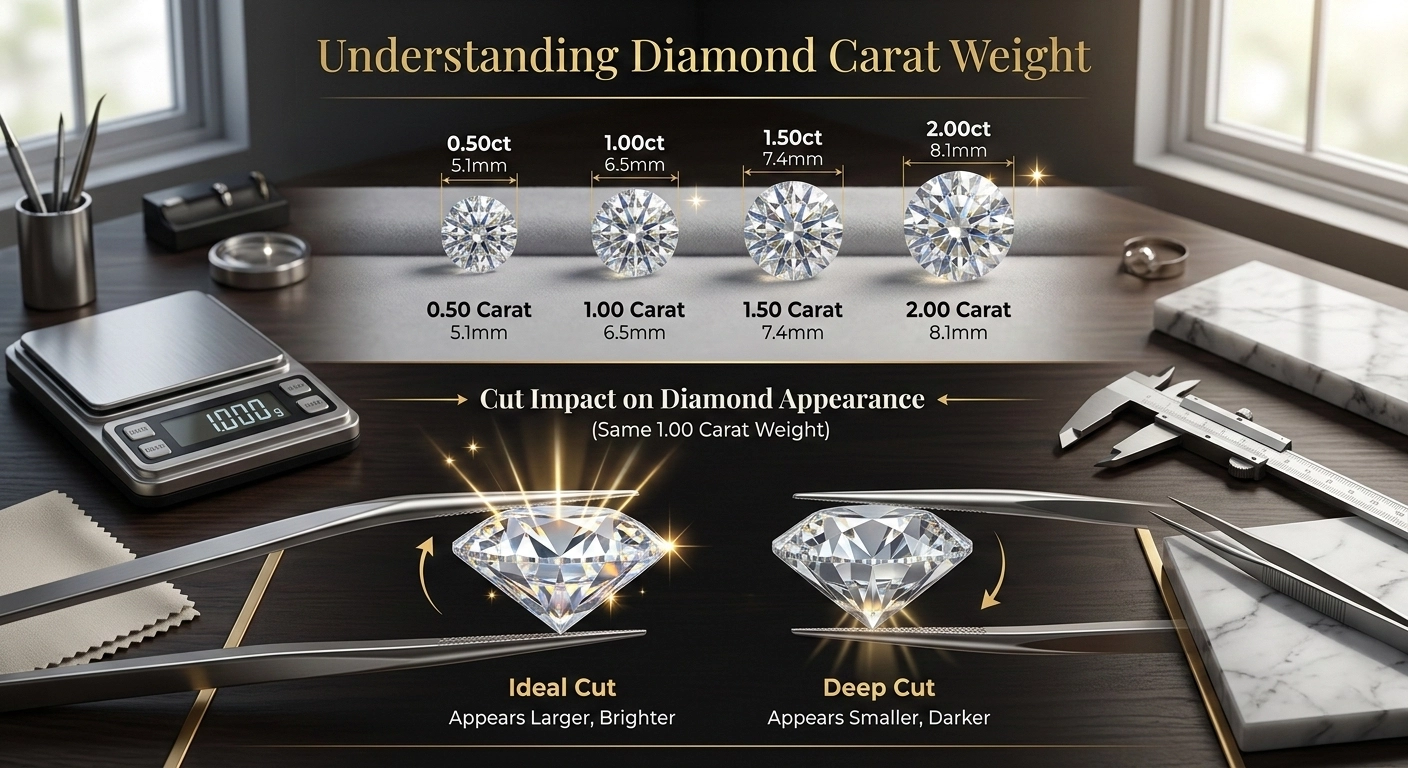
From a manufacturing perspective, a superior cut can actually make a diamond look larger than a heavier stone with an inferior cut. This is because a well-cut diamond has edge-to-edge brightness. A poorly cut stone often has “dead spots” or a dark center, which makes the stone appear smaller to the eye. When advising clients or selecting stones for a custom CAD design, prioritizing a “triple excellent” cut (Excellent Cut, Symmetry, and Polish) often yields a more impressive final product than simply choosing the highest carat weight possible.
The exponential pricing structure of magic weights
Diamond pricing does not follow a linear path; it is exponential. As diamonds increase in size, they become significantly rarer in nature, and the price per carat jumps accordingly. This is most evident at “magic weights”—thresholds like 0.50ct, 0.70ct, 0.90ct, and especially 1.00ct.
A diamond that weighs 1.00 carat can cost 20% to 30% more than a diamond weighing 0.98 carats, even if all other quality factors (Color, Clarity, and Cut) are identical. To the naked eye, there is no discernible difference between a 0.98ct and a 1.00ct stone. This presents a “buying shy” strategy for jewelers. By sourcing stones just below these magic thresholds, you can offer clients a diamond that looks identical to a larger stone but at a much more accessible price point.
How diamond shape influences perceived size
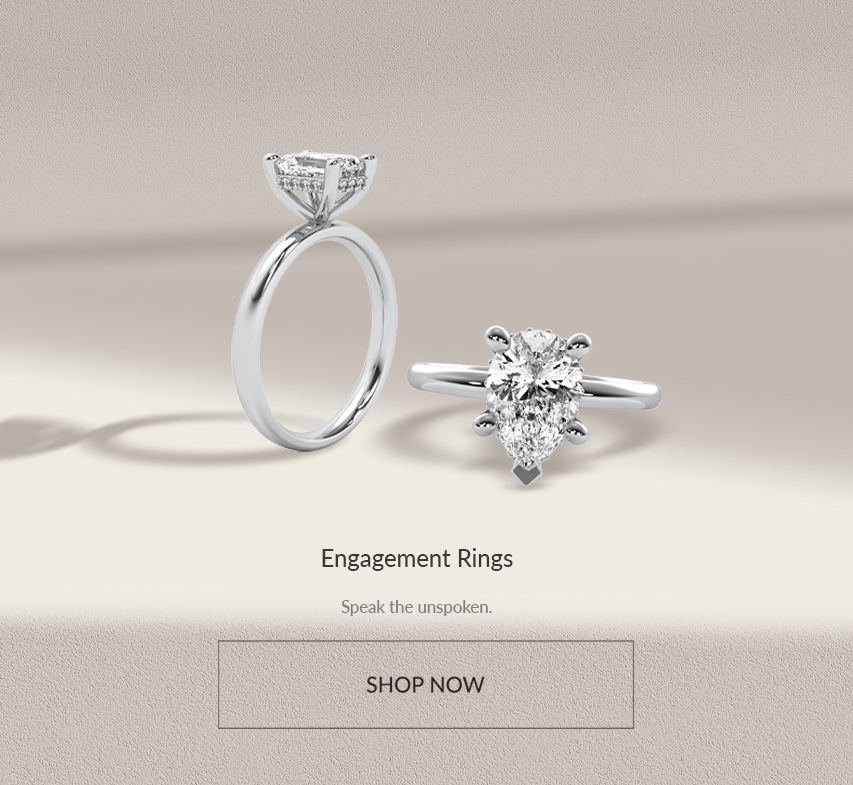
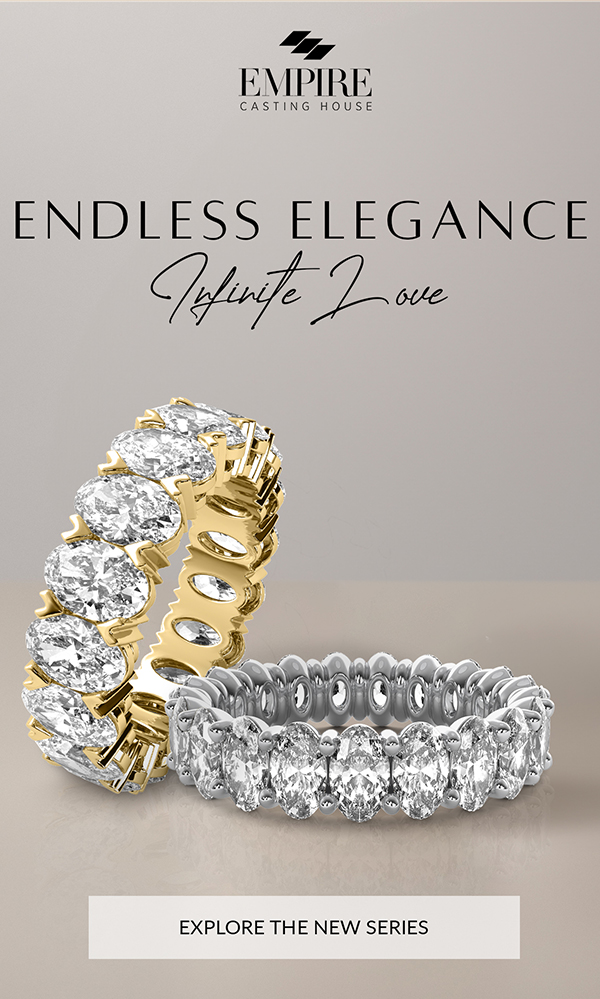
The shape of the diamond, or the “fancy cut,” plays a massive role in how large the carat weight appears. Different shapes distribute their mass differently. For example, elongated shapes like ovals, marquises, and pear shapes generally have a larger “face-up” area than a round brilliant of the same weight.
- Ovals and marquises: These shapes are excellent for maximizing visual impact. Due to their length, they often appear significantly larger than round diamonds and have the added benefit of making the wearer’s finger look longer and more slender.
- Emerald and asscher cuts: These are “step cuts.” They do not hide weight well and often have a smaller face-up surface area compared to rounds. They rely on clarity and luster rather than brilliance.
- Cushion cuts: Often cut deeper to retain color (especially in fancy colored diamonds), cushions frequently look smaller than their carat weight would suggest.
Understanding carat weight (CW) versus carat total weight (CTW)
In the manufacturing of multi-stone rings, such as halos or three-stone settings, it is vital to distinguish between Carat Weight (CW) and Carat Total Weight (CTW). CW refers specifically to the weight of the center stone, while CTW is the sum of all diamonds in the piece.
When designing a piece in CAD, the proportions of the side stones must complement the center stone. A common professional tip is that a smaller center stone (e.g., 0.50ct) can be made to look like a 1.00ct stone by using a well-proportioned halo setting. This allows the jeweler to achieve a high-impact look while keeping the costs of the raw materials lower for the client.
Strategic considerations for the professional jeweler
When preparing a professional order or a blog guide for your own clients, the goal should always be “balanced beauty.” A massive 2.00-carat diamond with a “Fair” cut and low color will often look less impressive than a 1.50-carat stone with “Ideal” proportions and high clarity.
As experts in New York’s diamond district, we see that the most successful pieces are those where the CAD design, the metal choice, and the diamond selection work in harmony. Whether you are working with Lab-Grown diamonds—which allow for much larger carat weights at lower prices—or natural stones, the principles of proportion and light performance remain the same. Always encourage the selection of a stone that “faces up” correctly for its weight, ensuring that the finished jewelry reflects the highest standards of the craft.